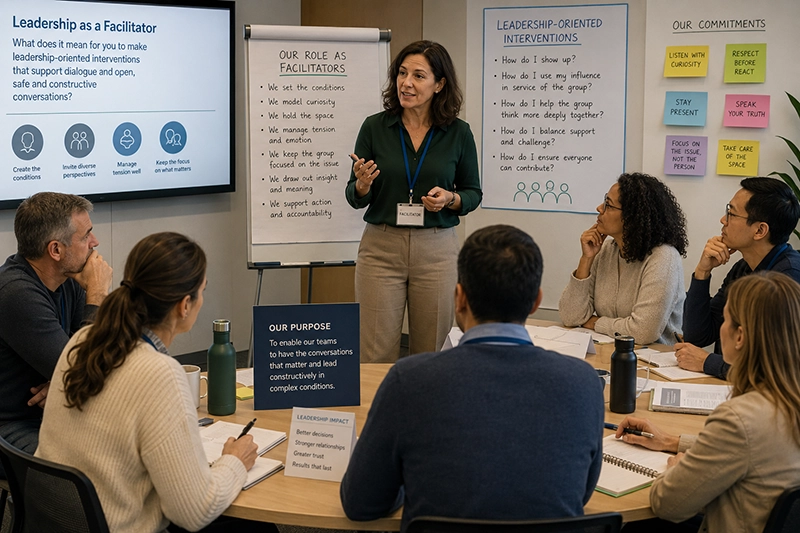
More About Developing Leadership Practice Capability
Leadership as Work, Practice
For many years, I have found it helpful to differentiate two forms of action – though not in a hard, either/way; more a recognition that both forms exist and are complementary.
Management action is largely concerned with organisation, coordination and specialist expertise in situations that are presumed to be well understood. The emphasis is on things like analysis, planning and execution within a given frame, a set of assumptions – though these are probably implicit rather than clearly stated.
Leadership action is particularly important when there is less clarity about the way ahead. Things are uncertain; there are differing – maybe competing – perspectives, potentially difficult relationships, and other significant questions to be examined.
While management-oriented action is just as important as leadership, it can be easy for organisation to fall uncritically into an emphasis on management as a way of working. This reflects factors like pressures to deliver on expected results as well as discomfort and threat implied by stepping into the uncertainty associated with leadership work.
Seen in this way, leadership is not something exercised only by people holding senior authority. It is a form of work that people throughout an organisation can contribute to: helping others notice what’s happening, questioning assumptions, engaging across differences, surfacing issues that might otherwise remain unspoken, and developing clearer shared understandings from which useful action can emerge.
As such, developing leadership practice capability is not so much about introducing new leadership models and tools as it is about strengthening people’s capacity to exercise leadership in situations they actually encounter.
Learning Through Real Work
Wherever possible, I work with real and current organisational situations, including both broader issues and those faced by individuals.
Participants might explore a difficult cross-functional issue, an emerging change, a relationship that has become stuck, differing views about priorities, or an issue that people have been discussing without making much progress.
The intention is twofold: to develop greater understanding of the issue itself and, at the same time, to develop participants’ capacity to think and engage effectively in comparable situations in the future.
This makes leadership development closely connected with everyday organisational practice rather than something that happens separately from it.
Strengthening how People Think and Engage
A recurring focus is helping people recognise what can happen to their thinking and interaction when pressure increases. We can react before observing carefully, form judgments about others without sufficiently exploring their perspectives, or dance around matters that feel difficult to address.
Practices drawn from OBREAU provide practical ways of interrupting these tendencies. They encourage people to observe more carefully, approach other perspectives with greater attributions of reasonableness, and speak authentically while remaining attentive to their impact on others.
In this sense, the work encourages both mindful and relational practice: noticing more of what is happening rather than operating automatically, while also paying close attention to how our ways of thinking and acting can play into issues and affect the people with whom we are working.
The aim is not to make conversations slower or more elaborate for their own sake. It is to help people become more capable of pausing when it matters, making better sense of difficult situations and acting with greater intentionality.
From Understanding to Action
For complex issues, moving quickly to solutions can sometimes reinforce the very patterns that are creating difficulty. A stronger approach can be to develop a clearer picture of what is happening, examine different perspectives and assumptions, clarify what matters, and then identify sensible experiments or next steps.
These experiments provide an opportunity to learn from action rather than assuming that a complex situation can be solved through a single decision or intervention.
Different Ways of Working
This approach can be incorporated into leadership development programs, workshops for established groups, facilitated work on significant organisational issues, or development for internal OD, L&D and other capability-building practitioners.
The format can range from a focused workshop or short series – such as Thinking Together Under Pressure – through to longer-term work in which participants practise the approaches repeatedly with issues arising in their work.
I can also work with internal facilitators and capability builders to help them adapt and use these practices confidently within their own organisations. My preference is to build capability that can continue without ongoing dependence on me as an external consultant.
Across these different forms, the underlying purpose remains much the same: helping people become better able to think clearly, engage constructively and exercise leadership when the situation is serious, uncertain or difficult.