
Collective Sense-making Labs
Groups practising thinking more productively on organisational issues
When faced with complex or uncertain issues, groups often respond, in my experience, by gathering more information, holding planning meetings and seeking solutions. Yet such responses are often insufficient. Complex challenges require people to think together in ways that help them notice what matters, understand diverse perspectives, and develop richer shared understandings before deciding what to do.
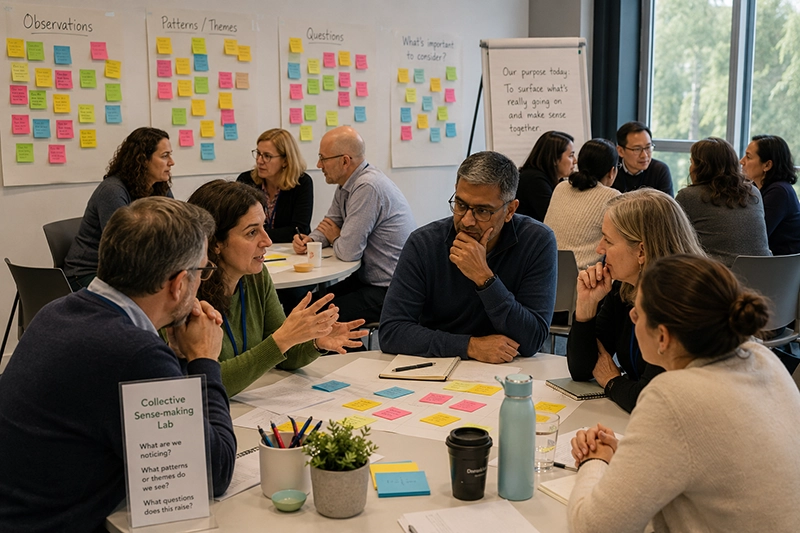
The Collective Sense-making Lab provides a structured process for doing this work. Focusing on one or more carefully chosen organisational issues, participants explore observable evidence, consider different stakeholder viewpoints, and reflect on their own authentic responses.
Collective Sense-making Labs can add real value when combined with strategic planning efforts, leadership development programs, organisational change initiatives, or when working through issues and questions in areas such as safety and quality, service improvement, culture development, risk, and innovation.
Working with Issues that Matter
Each Lab is designed around one or more issues, questions, or challenges that matter to the client.
A Lab might focus on a single issue, such as a change effort that has slowed or become stuck, an emerging organisational risk, or differing views about how work needs to change. Alternatively, and especially with an executive team, senior group or development cohort, it might explore several related or distinct issues in parallel.
The Lab approach is not intended to have everyone necessarily agree or come up with immediate solutions. The emphasis is on understanding the issues more fully, to provide a solid platform for subsequent action.
What Kinds of Topics Might Be Explored?
There are many possibilities, but a few examples might include understanding:
• What is getting in the way of an important change effort?
• What does psychosocial risk look like in our organisational context, and where might it be arising?
• How should work, roles or responsibilities change as AI becomes more widely used?
• Why are different parts of the organisation experiencing the same issue so differently?
• What are we learning from a recurring organisational problem that has proved difficult to resolve?
Labs are especially beneficial for issues or challenges that need better understanding, involve differing perspectives, and don’t have a single solution.
What Happens in a Lab?
The specific design will depend on the issues, participants and time available. Typically, however, participants will work through several related types of inquiry:
• Clarifying the questions or issues the group is trying to understand
• Distinguishing what is directly observable from interpretations and conclusions being drawn
• Identifying patterns, contextual factors and information that may have been overlooked or under-emphasised
• Exploring how the situation might be understood from the perspectives of different people or groups
• Surfacing assumptions, tensions and uncertainties that may be shaping the conversation
• Identifying questions warranting deeper exploration
• Considering possible aspects needing to be addressed that have been undiscussed till now
• Drawing together what has become clearer and what this suggests about possible next steps.
Much of the work usually takes place through structured conversations in small groups, interspersed with whole-group reflection and sense-making.
In some Labs, everyone may work on the same issue throughout. In others, particularly where more time is available, participants may work on different aspects of one larger issue or explore several issues in parallel.
An Option for Exploring Several Issues in Parallel
A longer Lab can be designed so that participants make progress on several issues at the same time, while ensuring that everyone has some exposure to the work on each issue.
For example, an executive team of twelve might identify three issues needing attention and begin by dividing into three groups of four. Each group would focus on one issue, generating, reviewing and exploring observations about what is happening. The groups would then share their initial work with the larger group, making visible both common patterns and differences between the issues.
After a break, new groups could form around each issue. At least one person from the original group would remain as a host, carrying forward the emerging inquiry and helping the new group understand what has already been generated. The other participants would bring fresh perspectives to the issue, using an abbreviated form of perspective-taking dialogue to consider how different stakeholders might understand or experience the situation.
Following a further break, perhaps including lunch in a full-day Lab, new groups could form again. With the host continuing to provide continuity, these groups would respond to and build on what has been generated so far. They might identify implications, questions requiring further investigation, possible experiments or conversations, and areas where the organisation needs to pay closer attention.
The groups would then report back to the larger group. In this way, everyone would have had some direct involvement with each issue, while each issue would also have benefited from continuity, fresh thinking and multiple perspectives.
This is one possible design rather than a fixed sequence. The number of issues, group size, length of each round and balance between continuity and movement would be adapted to the situation.
The value of this approach is that it allows an organisation to cover more territory within a given amount of time and personnel commitment, without treating any one issue as the only matter worthy of attention. It can be particularly attractive where people recognise that several issues are interconnected or pressing, but do not want to over-focus on a single topic.
The same model can work well with a leadership development cohort. Participants can bring live organisational issues into the Lab, practise the disciplines of collective inquiry, and learn from the different ways groups approach complex situations. In this respect, the format has some of the qualities of concentrated action learning, while placing greater emphasis on observation, perspective-taking and shared sense-making before action is agreed.
Using the OBREAU Practices
The Labs draw on the three OBREAU practices of Observation, Reasonableness and Authenticity.
These help participants move beyond some familiar defaults that can become particularly strong when an issue is difficult or the stakes are high:
Observation encourages people to move beyond reacting and look more carefully at what is actually happening.
Reasonableness helps people move beyond judging and make a serious effort to understand perspectives different from their own.
Authenticity helps people move beyond dancing around important matters and consider what needs to be said or explored more directly.
These practices provide disciplines for improving the quality of collective thinking throughout the Lab, whether participants are working on one issue or moving between several.
What Might Come Out of a Lab?
A Lab is designed as an exploration to help build shared understandings and clarify areas for experimentation and other work.
Specific outcomes might include:
• A more grounded and shared understanding of what is happening
• Previously overlooked perspectives or aspects of an issue becoming visible
• Assumptions or areas of disagreement becoming clearer
• Connections between different issues being better recognised
• Identification of a small number of questions for further attention
• Identification of experiments, conversations or other next steps
• Greater capability among participants to think together about difficult issues.
Where several issues are explored in parallel, the outcome may be a clearer picture of each issue, as well as a better understanding of how they relate to one another and where attention might be most usefully directed next.
Designed Around the Situation
In shaping a lab, the starting questions, participant group, preparation, structure and length are worked through with the sponsoring organisation. A shorter Lab (say, 2 to 3 hours) might focus quite tightly on one question. A longer Lab (say, half a day or longer) can allow for deeper exploration, parallel small-group work on different issues or dimensions, movement between groups, and more opportunity to bring different perspectives back together.
A multi-issue design needs enough time for participants to understand the purpose of each round and for hosts to carry forward what has already been generated. It is not intended to give every issue the same depth that a dedicated Lab could provide. Its strength lies in combining breadth with disciplined inquiry, continuity with fresh perspectives, and progress across several fronts.
Depending on the purpose, a Lab might involve a relatively small group of people closely connected with an issue, bring together participants with deliberately different perspectives, or form part of a leadership development programme.
Whatever the design, the underlying aim remains consistent: to create conditions in which people can observe more carefully, understand different perspectives more fully, speak more authentically, and develop better shared understandings of issues that matter.
Find Out More
To discuss any of these ways in which we might work together, please get in touch. Don Dunoon is happy to meet with you for an obligation-free 30-minute session to discuss your needs and possible ways forward.